
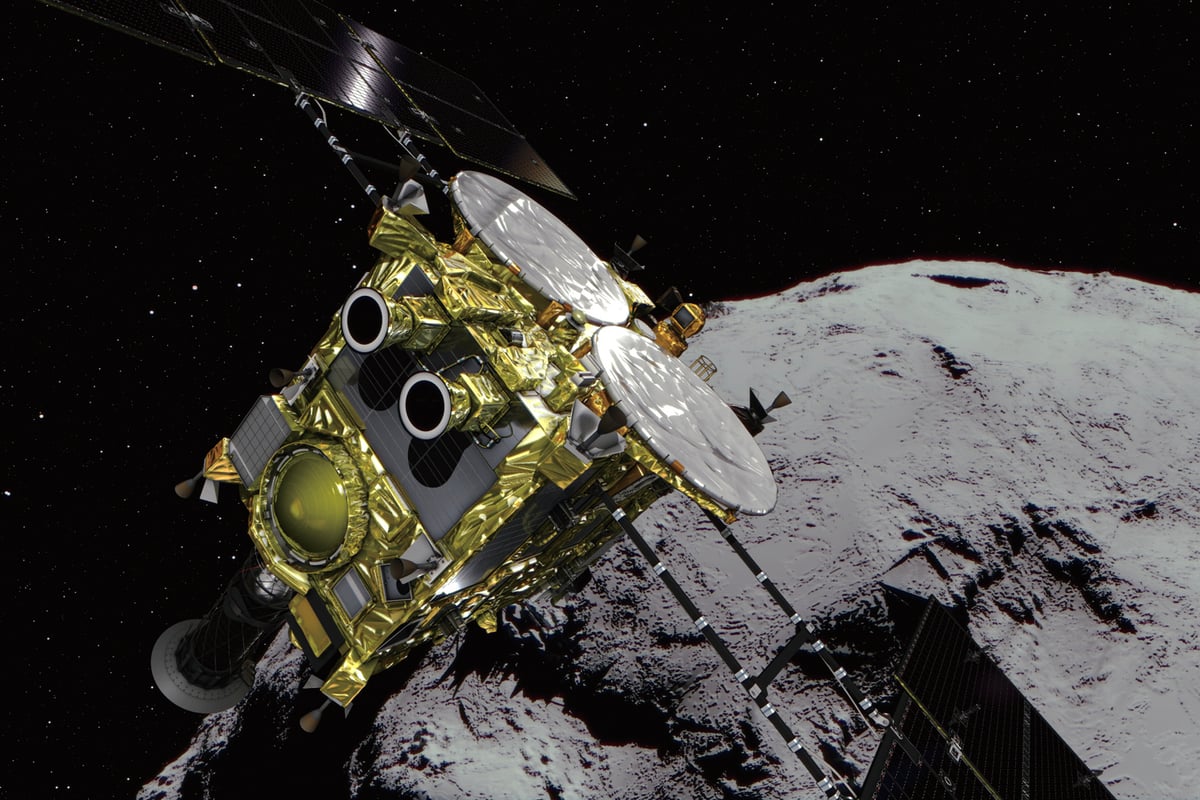
A Japanese space explorer has arrived at an asteroid 170 million miles away from earth after a three and a half year journey.
The unmanned Hayabusa2 spacecraft will attempt three brief visits to the asteroid in the next year and a half in the hopes of collecting samples to bring back to earth.
If the spacecraft is successful in its retrieval, the asteroid could provide vital clues to the origin of the solar system and life on Earth.
The Japan Aerospace Exploration Agency (JAXA) said the spacecraft reached its base of operations about 12 miles from the asteroid.
The robotic explorer will spend about two months looking for suitable landing places on the uneven surface. Due to the high surface temperature, it will stay for only a few seconds each time it lands.
 Images released by JAXAJAXA via AP
The asteroid, named Ryugu after an undersea palace in a Japanese folktale, is about 900m (3,000ft) in diameter.
In photos released by JAXA, the Japanese space agency, it appears more cube-shaped than round.
A number of large craters can be seen, which Project Manager Yuichi Tsuda said in an online post makes the selection of landing points "both interesting and difficult."
The first touchdown is planned for September or October.
Before the final touchdown scheduled for April-May, Hayabusa2 will send out a squat cylinder that will detonate above the asteroid, shooting a 2kg copper projectile into it at high speed to make a crater.
Hayabusa2 will hide on the other side of the asteroid to protect itself during the operation and wait another two to three weeks to make sure any debris that could damage the explorer has cleared.
It will then attempt to land at or near the crater to collect underground material that was blown out of the crater, in addition to the surface material from the earlier touchdowns.
Read More
The spacecraft will also deploy three rovers that do not have wheels but can hop around on the surface of the asteroid to conduct probes.
 Asteroid Ryugu JAXA-Tokyo University
Hayabusa2 will also send a French-German-made lander to study the surface with four observation devices.
Asteroids, which orbit the sun but are much smaller than planets, are among the oldest objects in the solar system.
As such, they may help explain how Earth evolved, including the formation of oceans and the start of life.
Hayabusa2 was launched in December 2014 and is due to return to Earth at the end of 2020.
An earlier Hayabusa mission from 2003 to 2010 collected samples from a different type of asteroid and took three years longer than planned after a series of technical glitches, including a fuel leak and a loss of contact for seven weeks.
Nasa also has an ongoing asteroid mission. Its Osiris-Rex spacecraft is expected to reach the asteroid Bennu later this year and return with samples in 2023.
Additional reporting by Press Association