
As Canada's rail network contends with record summer heat, a second train derailment in the United Kingdom this week has underscored similar safety challenges that rail operators in the United States are also monitoring.
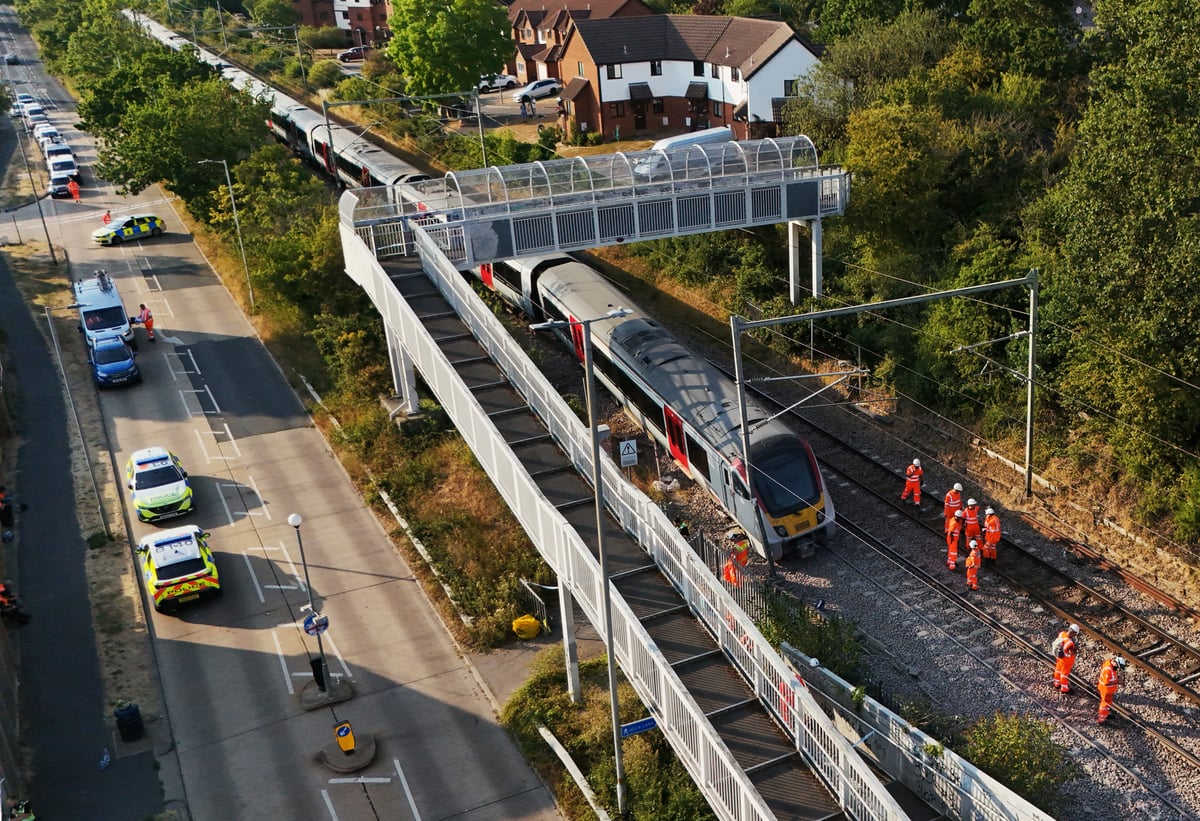
Greater Anglia train derailed near Wickford in Essex on Friday afternoon, in the second derailment on the UK rail network in 24 hours.
The service, which was running from Southend Victoria to London Liverpool Street, came off the tracks in Wickford at 2.12pm BST on Friday, with around 45 passengers on board.
The British Transport Police confirmed that there are no reported injuries, and that officers, paramedics and firefighters were at the scene after reports that the rear carriages of the train derailed in an upright position.
Travel disruption
The incident caused travel chaos, with Network Rail warning passengers that "major disruption" will continue until at least Saturday, including for those going to Southminster and Braintree.
National Rail said that no trains would run between Wickford and Southend Victoria until at least the end of the day.
Emergency response
An air ambulance landed close to the scene off Salcott Crescent as a precaution, alongside police, firefighters and paramedics, while the Rail Accident Investigation Branch also deployed a team of investigators to gather evidence.
Essex County Fire and Rescue Service said: "Essex County Fire and Rescue Service is currently supporting the emergency response to an incident near Wickford. Our firefighters are working alongside other emergency services and partner agencies at the scene."
Local residents handed out bottled water and ice lollies to emergency crews working in the 33C heat. Local councillor Danielle Belton wrote on Facebook: "My office is behind the track at Shotgate and we felt the building rattle quickly followed by a helicopter overhead."
The derailment comes after two people were seriously injured in a separate train derailment in Lewes on Thursday.
The Department for Transport has stressed that Britain's railways were "among the safest in the world" as it reacted to the incident, adding that derailments were "incredibly rare" events.
Investigations into the two derailments "will look at all possible causes and factors", a Network Rail boss said, noting that the hot weather had presented exceptional challenges to the railway.
Martin Frobisher, group safety and engineering director at Network Rail, said: "I appreciate the public will be concerned at the news of two derailments of passenger trains over a short period of time, but I want to reassure them that Britain's railways still rank among the safest in the world, and that safety is always our first consideration on the railway. I want to thank the teams from across the rail industry and emergency services who have been working around the clock to provide assistance and support to those who need it, as well as the response from the local community." He added: "The unprecedented hot and dry weather that we have experienced this summer has presented exceptional challenges to the railway. In response, we have taken several additional proactive steps to manage and mitigate the impact on the railway, including closely monitoring the temperature of tracks, implementing speed restrictions where appropriate, and planning track renewals around high temperatures."
Canadian and U.S. rail operators have similarly begun to monitor track temperatures more closely this summer, citing the same heat‑related risks that prompted the UK warnings.