
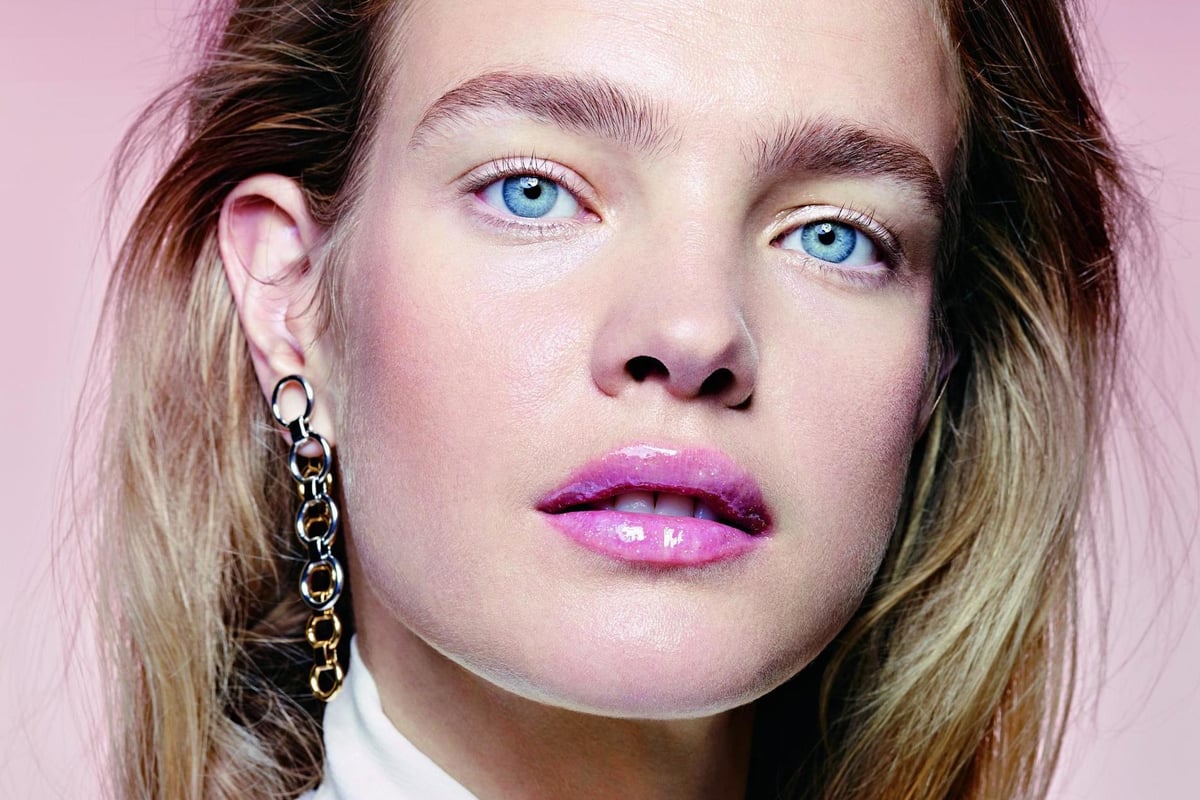
Natalia Vodianova has the accent of a seductive James Bond villainess: husky and indeterminate, her native Russian laced with Parisian fricatives. She’s probably a good deal tougher than Bond though, despite her bone-snapping appearance. She has a focused determination that seems uniquely Russian: unrelenting and hard. Whereas the cliché once belonged to gymnasts and piano players, Russia now seems to export these gritty female entrepreneurs whose work ethic makes us all look idle.
Last time I met her she was eight months’ pregnant and wearing a sweatshirt over a bump the size of a bum bag. Two babies in the intervening three years and I detect a little concealer around the eyes, maybe a shallow frown line. At 35 she’s a mother of five (five!). Is she done? ‘For a while,’ she smiles. ‘I need to just make sure I do well with everything else I have on, which is a lot.’
Yes, well she certainly packs it in. There’s the modelling from which she made her name, a £20m career trimmed to an efficient 20 days a year. Then there is her Naked Heart Foundation, which has raised £30m since 2004 for children with disabilities. Four years ago she launched Elbi, an app which allows people to ‘micro donate’ by pressing a ‘love button’. She calls it ‘a philanthropy collective’, happily reclaiming a word once soaked in communist propaganda.
‘It’s a very Russian idea,’ she continues. ‘You don’t have 100 roubles but you have a hundred friends. It’s the alternative to billionaires who donate to certain causes and who choose where this money should go. It’s about collective power.’
 Caroline Weinberg, Natalia Vodianova, Cara Delevingne and Doutzen KroesDave Benett/Getty Images for Por
It’s tempting — oh, so tempting — to see her as another rich celebrity patronising the poor and relieving their consciences with ‘good works’. After all, she was married aged 19 to the aristocrat Justin Portman, 13 years older, whose family coffers pulsate with revenue from the large chunk of central London they own. Now she lives with the father of her two youngest children, Antoine Arnault, the son of Bernard Arnault, the owner of LVMH, worth £43.5bn and ranked the eighth richest person in the world. Arguably she has a Marie Antoinette existence in central Paris with a view of the Eiffel Tower from her apartment — C’est génial! — and any material thing her fluttering heart desires.
Read More
But that is to oversimplify. Hers is a rags-to-riches story: a childhood below the poverty line in Nizhny Novgorod, a bleak and grim industrial city in western Russia. She and her mother, Larissa, were abandoned first by her father, then her stepfather after her half-sister Oksana was born with autism and cerebral palsy. Sometimes a sachet of dried soup was all she ate in a day. By 11 she was selling fruit by the side of the road. Cold, hunger, survival — these were not alien or romanticised concepts. The mark of poverty is still on her, she says, most explicitly in her understanding of the ‘shame’ that surrounds it. When I ask if she can see it in others, she surprises me: she starts to cry. It touches something visceral.
‘It’s a very emotional question. For those simple families who nobody cares about, really living with that stigma [for example] of disability, then even if I give them money, it’s not enough. The best thing I can do is spend time with them listening and to share my story. And, yes, we cry a lot. Usually.’
 Vodianova with her children’s furniture range for made.com
 She says shared traumatic experiences — whether it is living in poverty, with someone disabled, or losing someone to cancer — transcends friendship, nationality, blood ‘or any other bond’. In an ideal world, she says, we would draw on our experiences to comfort one another more often. ‘We have blind corners in our lives; we may have next door someone who we could understand.’
I’m sure psychologists could find an unconscious link between the hardship of childhood and her attraction to extremely rich men, but one driving ambition has been to improve her mother’s life.
‘And I have succeeded. My mother has a little business and is independent. She can buy me presents that I did not pay for.’ She says Larissa instilled in her two things: self-reliance and a steely drive. (‘I tell myself this is the heritage I am leaving my children: a work ethic.’)
‘My mother was in a desperate situation, working four jobs, raising kids alone. From a young age she taught me: “Only rely on yourself. You have to be strong. No one will do anything for you; you have to do it for yourself.”
‘And she lived it. I had this idea that the government is a faraway thing that does not affect me, touch me or help me.’
 With, from left, Oksana, Kristina and their mother, Larissa
Of course, her children are growing up in a different universe, with easy proximity to the French government. Vodianova has met Emmanuel Macron, and Macron’s wife, Brigitte, is friends with Antoine’s sister, Delphine. (I make a terrible faux pas by asking if Delphine helps Brigitte with her wardrobe — ‘Ha! Delphine is a businesswoman, not a stylist. How funny that you thought she was a stylist. I must tell her.’)
We sidetrack to discuss the age difference between the President and his wife — it’s 25 years — and Vodianova gives me a Gallic shrug and says this is not unusual in Paris. ‘I often see it where you have this incredibly handsome young guy with this beautiful older woman — and obviously much older. It’s quite common. If he wasn’t the President, no one would blink.’
We are sitting in the showroom of Made.com on Rue Étienne Marcel surveying yet another of her projects combining tech and fundraising: a children’s furniture range she has designed for the online company co-founded by her buddy Brent Hoberman of lastminute.com fame. A bedroom scene — bed, wardrobe, bookshelves decorated with matryoshkas — has been set up in a little tableau vivant beside us in. Vodianova tells me she met Hoberman through Founders Forum and he insisted she get involved, which wasn’t a chore as she loves tech (‘It’s where everything is going’). Most importantly, all proceeds go to Naked Heart.
 The Naked Heart Foundation Fund Fair
She takes me through the detail — the pull holes for drawers to stop little fingers getting trapped: ‘This is a phobia for me because when I was five someone closed the door on my finger. I still remember the pain.’
So what was her own bedroom like growing up? ‘I didn’t have a bedroom,’ she says. ‘Every single one’ of her children — Lucas, 16; Neva, 11; Viktor, 10, with Portman; Maxim, three; and Roman, one, with Arnault — have just done a publicity shoot here and ‘loved it’, she says.
She softens when she is talking about her kids, flipping one thigh-high boot over the other, her rod-straight back dissolving a little. They were all breast-fed, ‘which is very, very tiring. None of my children slept, so for the last 15 years I’ve been up every night twice at least. The baby is my bonus for all the hard work I’ve done: he’s a saint.’
 Mario Testino, Natalia Vodianova, Patrick Demarchelier and Anna WintourGetty Images
She has help — ‘Of course, or I wouldn’t be here’ — and keeps tabs on each of them by carving out one-on-one time. ‘I have moments where I feel I’m losing control of one — that’s motherhood. Naturally babies get priority, but then it’s about working out which child needs extra time.’
They don’t complain, although recently she overheard the youngest of the Portman brood saying to the eldest: ‘Yes, but you had mummy to yourself for four years.’ The three eldest moved to Paris from a rural Mill House in West Sussex in 2012. ‘It was exciting and scary. They were very courageous. Of course, they left friends behind and I do sense that they miss the pleasures of the countryside because they don’t have this in Paris. But they’ve settled well. And now they speak another language.’
Are they very Parisian now? She smirks. ‘No, they are still very English.’ In fact, Paris was the first European city the 17-year-old Vodianova experienced on arriving from Russia as a fledgling model. ‘I spent one year here as a girl with no money, going on the Metro, really discovering the city. And it’s probably the city I know the most out of my home town.’
 Natalia Vodianova and Justin PortmanWireImage
At 18 she moved to New York where she threw herself into her work. And it was there she met the sybaritic Portman, an artist and Prince Charming with a taste for models (more recently he was dating the Ukrainian Anna Shut, 23).
Vodianova could have lived happily ever after if her happily ever had been going to parties, looking pretty and staying up late. She once said that ‘the biggest differences between England and France is royalty versus republican and my marriages reflect that. My first husband was a member of the aristocracy, did not work but was a walking encyclopedia. My second husband is a workaholic.’
I ask her to elaborate. ‘I am a workaholic as well,’ she says brightly. ‘That’s why it didn’t work with my ex-husband. We loved each other but we separated like water and oil because we were just very…’ she searches for the elusive word. ‘Our everyday lives were different. Our rhythm of life was different.’ In the past she has described Portman’s parenting as ‘hands-off’. ‘With Antoine we love to get up in the morning, be with the children then go to work.’
The British aristocracy, she says, was ‘another world’, not necessarily welcoming to outsiders. ‘It’s a beautiful world, yes. But if you haven’t been born into it, it can be difficult to be part of. I was born into a working-class family. And then when things became really desperate I had to work. I was very young.’
 Vodianova with her children
By 19 she was married to Portman and had her first child. Not that it slowed her down. She stepped back on to the runway 10 days after giving birth and did 40 shows that season. ‘He had all this free time to follow me and our baby around in my crazy career. At the time I thought I knew everything. I thought that it didn’t matter that we were so different because we had complicity elsewhere. In emotional ways we were very supportive of each other.’
On returning to England they bought their rambling country house from Evelyn de Rothschild and filled it with children and animals. But the ‘glue’ of their relationship began to come apart. Vodianova’s patience with Portman’s partying wore thin.
She met Arnault in 2008 shooting for Louis Vuitton although she doesn’t remember it. They met again in 2011 and after two dates she was smitten. Moving her three children to Paris wasn’t difficult as Portman spends so much time wrapped in a sarong in a sprawling estate in Uruguay. But shortly after they separated Portman wrote a post on Facebook saying that his life was not in ‘synchronicity’ with her ‘fashion’ life. He claims she was embarrassed of him, treated him like an ‘old Louis Vuitton handbag’ and that after a stint in rehab he said she didn’t receive him home with any warmth.
 Fashion for Relief with Bella Hadid, Kendall Jenner and Naomi Campbell
She describes the 40-year-old Arnault — the chief executive of Berluti and the chairman of the Italian cashmere company Loro Piana — as ‘always happy to go to work: very driven and very hardworking.
‘For me work is my life. I guess in that sense we are very well balanced. He inspires me and I think I inspire him because of the same energy I give, but to philanthropy.
‘He is actually an incredibly compassionate person,’ she adds. ‘But like any man his view is, “Make your own money first, secure your career, your wellbeing, the wellbeing of your family and then you think of everything else.”’ She says she feels guilty about working so hard ‘especially when in principle I don’t have to work any more’. She says she compensates by having no time to herself — and anyway even when she tries she feels guilty. Last night, she says, she tried to enhance her evening beauty routine by five minutes.
 NataliaVodianovaand Antoine Arnaultattend the "The Art of Giving" Love Ball Naked Heart FoundationWireImage
‘I swear to God I am standing there doing this last night, thinking, “Agh, my husband is already in bed. I could be cuddling with him. Or I could be like chatting with my kids.” I tell myself, “Shut up — stop it. You’re crazy.”
‘But I can’t help it.’
To see the full Matryoshka children’s furniture collection designed in collaboration with Natalia Vodianova, go to made.com