
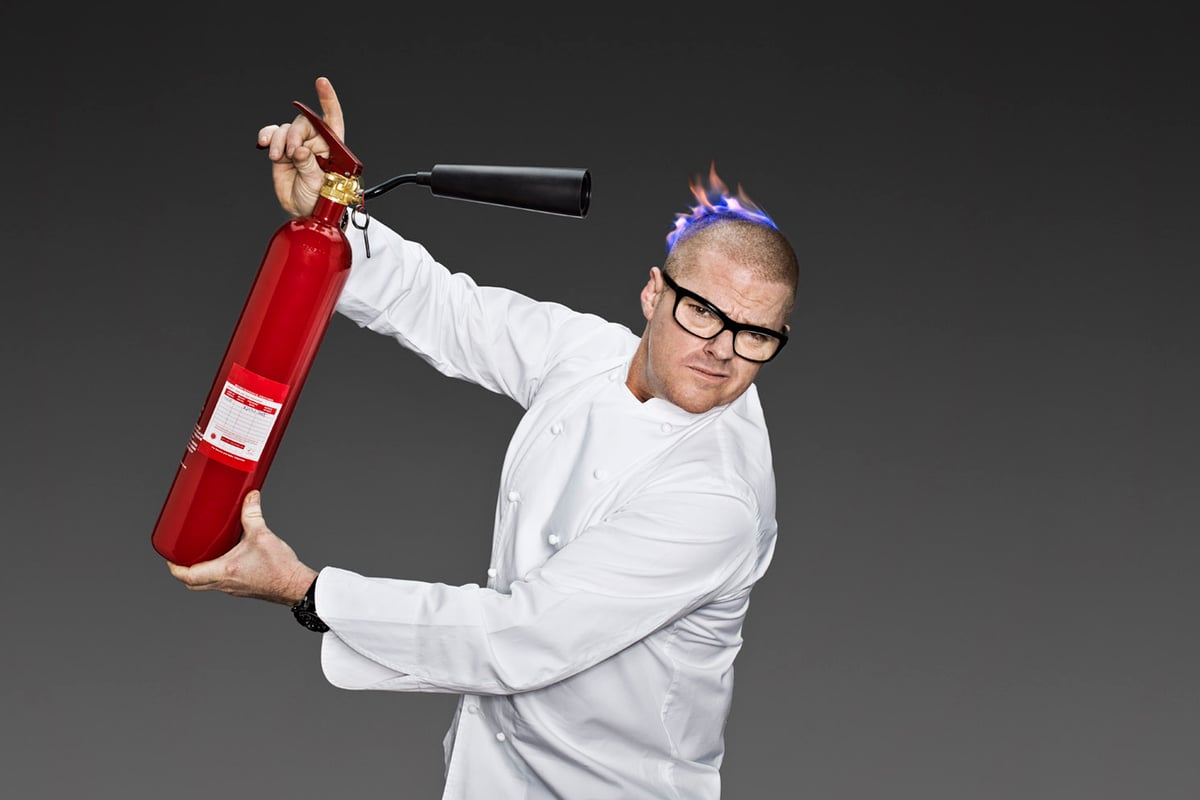
It’s almost that time of year when martyrs all over the city hunker down in their armchairs and reflect on the incredibly hectic year they’ve had, quite convinced that theirs was the busiest, most stressful year any high-flying Londoner has ever endured. They may want to spare a thought for Heston Blumenthal. Not content with closing The Fat Duck in Bray, transporting it 10,000 miles to a hotel and casino complex in Melbourne for six months, then reopening the Bray Fat Duck after a £2.5m renovation, Britain’s favourite non-molecular gastronomic (he disowned the term several years ago) chef also found the time to film a four-part documentary about the process (to be shown next year), work on new additions to his food range for Waitrose, consult on the current exhibition at the Science Museum (Cravings, about gut bacteria) and develop food for the first British astronaut, a process that saw his concoctions launched into outer space. ‘If somebody had said to me, as a kid, that my food was going to go up in a space rocket, and that the rocket would blow up…’ says Blumenthal reverently. ‘I mean, there was no one in it,’ he adds hastily. ‘But the flipping thing exploded with all our food in it.’
After 90 minutes with him, my own head feels in danger of exploding, too: God knows how exhausting/exhilarating it must be to inhabit a mind like his permanently. You don’t really ‘interview’ Blumenthal: you listen, he talks, and eventually he answers the questions you planned to ask him anyway, via a convoluted thought process as scattershot as one of his own menus and in language as nebulous as one of his foams. My first question (‘Can you explain the concept behind your new restaurant?’) elicits a 16-minute response. Oh, God. How will I ever steer him on to the mandatory ‘What do you cook for Christmas Day?’ It will be midnight before he tells me how not to f*** up the gravy.
 Bird Brain: one more bright idea
The new Fat Duck reopened in September and, predictably, is booked up until the second coming of Christ. Should you wish to secure a table, if you set your alarm for ‘12 noon on the first Wednesday in January’, you might be lucky enough to grab one for April. Tickets — yes, ‘tickets’ — are sold via the website, as if booking for the theatre. Which is fitting, since the meal is something of a performance. This isn’t just a matter of parking the car and eating a few triple-cooked chips. According to the website, you will be ‘reserving a place to join Heston on The Journey for a memorable day out’. And indeed, at £255 per head — not including drinks, plus 12.5 per cent service — one would expect The Journey to be memorable.
I can tell that you are deeply curious about the nature of The Journey, but before I cut through the nebulosity with my own prosaic, meat ’n’ two veg definitions, it would only be fair to allow Blumenthal to explain the dining concept first. Here goes: ‘So imagine: let’s smell a banana, see a banana, eat a banana, we will all be — it’s a bit like colour — eating a banana, but we’re not necessarily going to be tasting the same thing, because then it feeds into our memory, and it’s our memory that allows us to make a decision whether we like something or not. So this memory and nostalgic stuff, as that evolves, you think… I wanted it to be more of a story, and why did it have to go on the menu; why did it have to go down that road? I’m friends with [the Working Title film producer] Eric Fellner, so I phoned Eric and we started studying fairy tales and how to structure something in terms of fairy tales. There was the structure of Alice in Wonderland, for the meal, and all these scenes I thought... it’s just going to be too abstract for people to… maybe later on, further down the line, but how are we going to do this? Anyway, I phoned Eric and he said, “There’s a guy called Lee Hall who wrote Billy Elliot,” and so Lee came down, and we talked about fairy tales, and he looked at the menu and said, “It seems to me that you have all the bits of a day’s holiday here. You’ve got ice cream, you’ve got seaside, you’ve got sweet shop…” and that’s when the penny dropped, and that was it. Because it’s nostalgia, and it’s wanting to be personalised. I’m just telling a story, a memory of a day’s holiday, in fact it could all be real, it could be made up… and some of it, it doesn’t have to be from the same holiday and the same age. It’s all designed as a sort of catalyst… remember that Cadbury’s Creme Egg ad — “How do you eat yours?” ’ That’s an edited version of his full reply.
Lest it be deduced that diners are paying £255 to eat a Creme Egg on a simulated beach, I must now briefly lay out the three key points from what is my own understanding of the new Fat Duck, which are: 1) There is no menu. 2) Diners can expect a semi-bespoke culinary experience curated around their favourite foods. 3) Nostalgia is the theme, with evocative tastes aurally enhanced via music played through individual headphones. Clearly, it’s the perfect place to go if you have nothing whatsoever left to say to your partner. Stick some Prince on the iPod and bring me some Cheesy Wotsit ice cream forthwith.
Seeing as you could spend less money going for a romantic weekend in Paris, the price tag has proved inevitably contentious. But when you consider the amount of time, ingredients and manpower that go into creating each individual nostalgia trip, it’s kind of cheap at half the price — certainly if you’re rich. ‘It’s way too cheap,’ he confirms. ‘We’re just wearing it in.’
 Nobody here but us chickens: Heston Blumenthal at the Fat Duck
Given that the restaurant has 42 seats, I ask him how personalised the experience can feasibly be. ‘I didn’t want to go: “Right, well we’re going to tailor for people,” because firstly, people might expect you to do a whole 15- to 17-course menu individually for them. We’d need 400-plus chefs to do that!’ he says. That the restaurant critic Giles Coren was moved to tears by ‘a super maxi carrot choc ice’ — a physical manifestation of an imaginary concoction plucked from a story his father used to tell him as a child (and shared in advance by Coren’s sister Victoria) — is further proof, if any were needed, of food’s ability to evoke nostalgia. ‘Currently there is an awful lot of work being done on the power of nostalgia for stress and wellbeing,’ says Blumenthal. ‘You’re just remembering a nice warm moment.’ He recounts the tale of a couple who dined with him while going through divorce proceedings. ‘They’d booked a table and didn’t want to cancel because of the hassle of getting it. They sat down and [the meal prompted them to] started talking about their favourite chocolate bars. The next minute, they’re saying “Why are we getting divorced?” They told me: “I think you’ve just saved our marriage.” ’
Blumenthal’s own 22-year marriage dissolved in 2011, after which he dated American cookery writer Suzanne Pirret. They split up earlier this year: since then, his business has been the main love of his life. For Christmas, he is going to have ‘my first two-week holiday in about five years’, shutting The Fat Duck for three weeks ‘to go to the Caribbean and lie in the sun’ with a group of friends, including fellow chef Marcus Wareing. Christmas dinner will be whatever fish is brought in fresh by the local fishermen. ‘I’ve never had a Christmas meal that’s just been fish,’ he says ruefully. ‘Christmas Day is that time of the year when you want clichés.’
It’s the ultimate in nostalgia, I suggest. ‘Absolutely! Some TV producer once said to me: “Reinvent Christmas!” One — I can’t, because Christmas is Christmas, and secondly, I don’t want to, even if I could.’
 Mist opportunity: another Heston Blumenthal creation
The biggest mistake people make when cooking Christmas dinner? ‘One, they invite too many people. And secondly, they do too many things, and the timings go wrong. From a cooking point of view, the biggest bit of advice I could give is that you base everything around the roast potatoes. You can cook the meat and let it rest, cook the carrots, spring greens, cabbage, sprouts... all of that can be done and given a quick reheat. But roast potatoes — when they’re ready, they’re ready.’
How to make a sprout not taste like one of Satan’s farts? ‘Shred them, or, if you can be arsed, peel the leaves off, then chuck them into a pan, add a bit of onion and garlic and put them on a low to medium heat. You could put a bit of chilli in, some lardons, chestnuts if you want, and then the leaves. Put the lid on, and it should take six to eight minutes.’
And what about when you add children into the mix? My own cooking went to shit once my kids arrived: no time, and no desire to conjure up culinary delights that they’d reject on the basis that it wasn’t pasta and pesto. ‘My kids are nearly 23, nearly 21 and 17, so they’ve gone past that [fussy stage] now. But yes, it’s tricky. You see these programmes... “only ever eat free-range chicken” and “eat this” and “do this”, but we’re human beings, and there are days when you want to buy yourself a bit of time. My advice — and this is easier said than done if you’re a mum — is just to expose them to as many things as you can, and if they don’t eat it at least they’ve had a choice.’
Read More
We talk about many other things — how food can prevent cancer, how the education system is strangling creativity, how failure is a learning experience, how babies’ tastes develop in utero, how brined anchovies in a Caesar salad are just wrong, how the made-up word ‘amusharoolahara’ sounds more chocolatey than ‘skibikik’ — and, while he is passionate about every topic, he gets a special, lovestruck glint in his eye when we talk about The Fat Duck. However pretentious the concept, the mission is simple. It wants to feed people happy. ‘The best emotion in the world, for me, is happiness. Because it’s not dependent on what you want people to think of you. It’s your happiness.’
You’re not going to make any money off this, I suggest. ‘No,’ he agrees. ‘No way. It’s a total labour of love.’
Portraits by Neale Haynes