
At London’s most exciting new restaurant openings, the interiors are just as much of a draw as the food. The capital’s design-driven dining rooms are embracing craftsmanship, colour and plenty of ideas worth borrowing for our own homes.
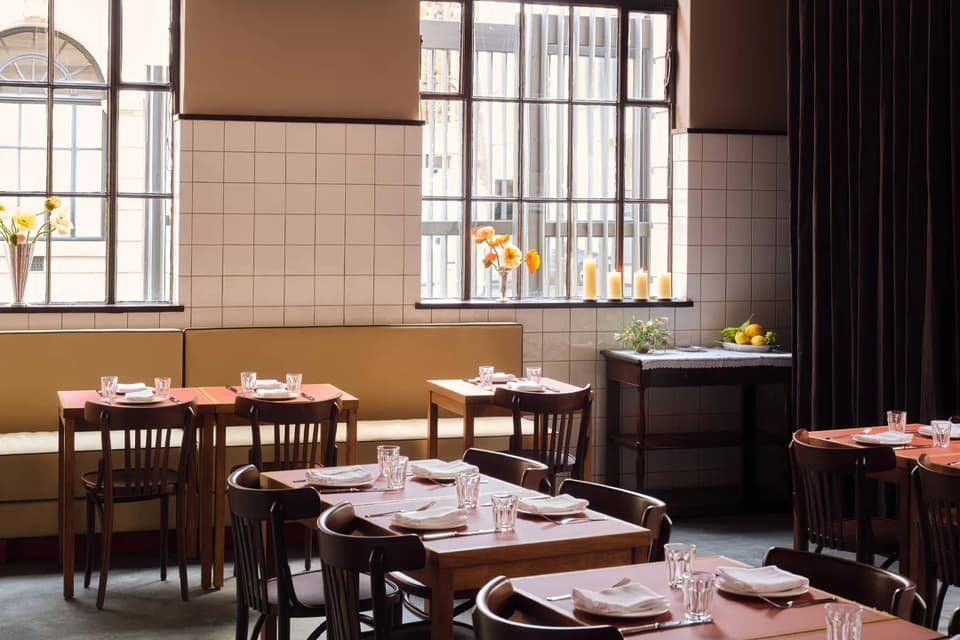
Nowhere is that more apparent than at Holy Carrot in Spitalfields, where designer Faye Toogood has created one of the year’s most distinctive interiors. Inspired by the restaurant’s vegetable-led menu and the area’s history as a fruit and vegetable market, the space combines white tiles, concrete, metal and raw canvas with artistic moments.
A hand-painted mural stretches across the walls, where human figures mingle with oversized vegetables in a dreamlike landscape. “Holy Carrot makes my sort of food,” says Toogood. “There is a simple and playful quality to their approach. I have created a space that feels like my own Platonic ideal of a restaurant. A classic bistro rendered by an abstract painter.”
That balance between restraint and expression is echoed at MIKO Mei Fair, housed within a Grade II-listed Georgian townhouse on Curzon Street. Designed by Tom Strother of Fabled Studio in collaboration with restaurateur Samyukta Nair, the interiors layer gold-leaf accents, hand-painted silks, marquetry cabinets and timber panelling to create a space that feels quietly luxurious.
“MIKO is a space where craftsmanship, materials and cultural references all work together without announcing themselves,” says Nair. “The intention was to bring a new sensibility to that framework, something warmer, more intimate, more layered.”
 Little Julie’sLittle Julie’s
A similar ethos lies behind Oudh 1722, Michelin-starred Aktar Islam’s restaurant inspired by the cultural legacy of the Indian city Lucknow. Designer Polina Sychova tells me, “The aim was not to recreate a historical setting, but to interpret that spirit in a contemporary way,” resulting in a space where food and design feel inseparable.
The dialogue between heritage and contemporary design also runs through Helena’s at The Sloane Club. Part of Russell Sage Studio’s £20 million transformation of the historic members’ club, the restaurant takes inspiration from Princess Helena’s connection to the Royal School of Needlework. Its centrepiece is a bespoke wallpaper by conservator Allyson McDermott, based on an embroidered bedcover from school’s archive.
“It is so lovely to take this thing, which nobody has really ever seen before, and create it as an homage both to Princess Helena and the craftsmanship and patience of women,” says McDermott. Russell Sage is also behind Café 1922, The Sloane Club’s first public-facing space. Designed as an all-day café that transitions into a neighbourhood wine bar by night, outdoor tables spill onto Lower Sloane Street.
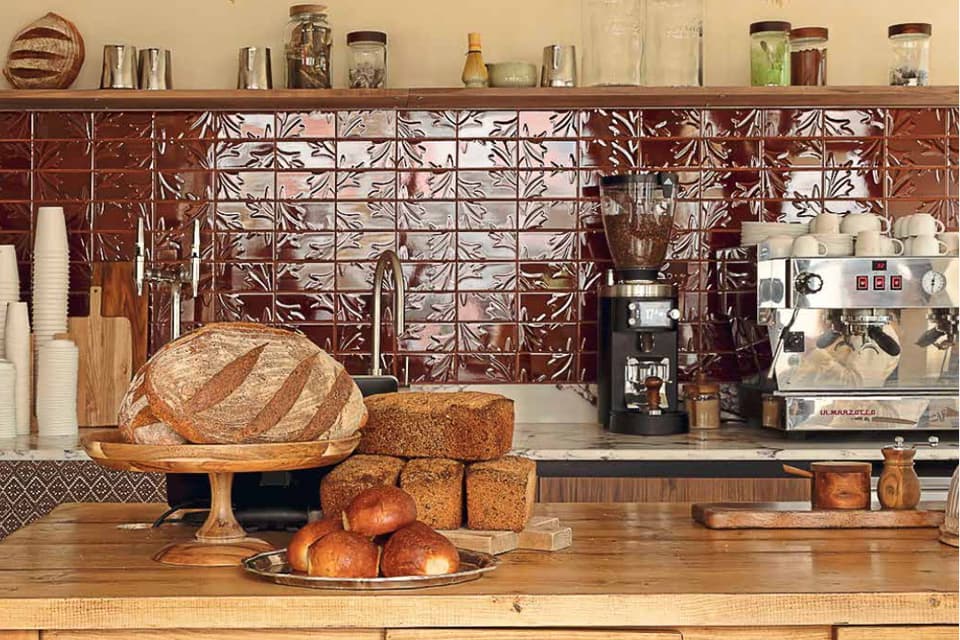
At Little Julie’s in Notting Hill, Petra Palumbo and Rosanna Bossom have transformed archival needlepoint motifs from Palumbo’s family design archive into bespoke tiles that wrap the counter and splashback.
“The starting point was the Tapisserie archive; we were drawn to the Mogul Khan Leaves for its sense of movement and botanical rhythm,” says Palumbo. The tiles are available to purchase at £120 for a set of six on petrapalumbo.com.
 Sale e Pepe Mare
In Eccleston Yards, Weezie’s feels more like a much-loved (and impeccably designed) home than a restaurant. Reclaimed furniture, hand-painted tiles by Flora de Boinville, a polished steel bar, and artwork by Kara Marshall sit alongside personal photography by owner and founder of Amie wine Abbie Sandbach. Fermoie fabrics and Rupert Bevan wallpapers add another layer of character.
Read More
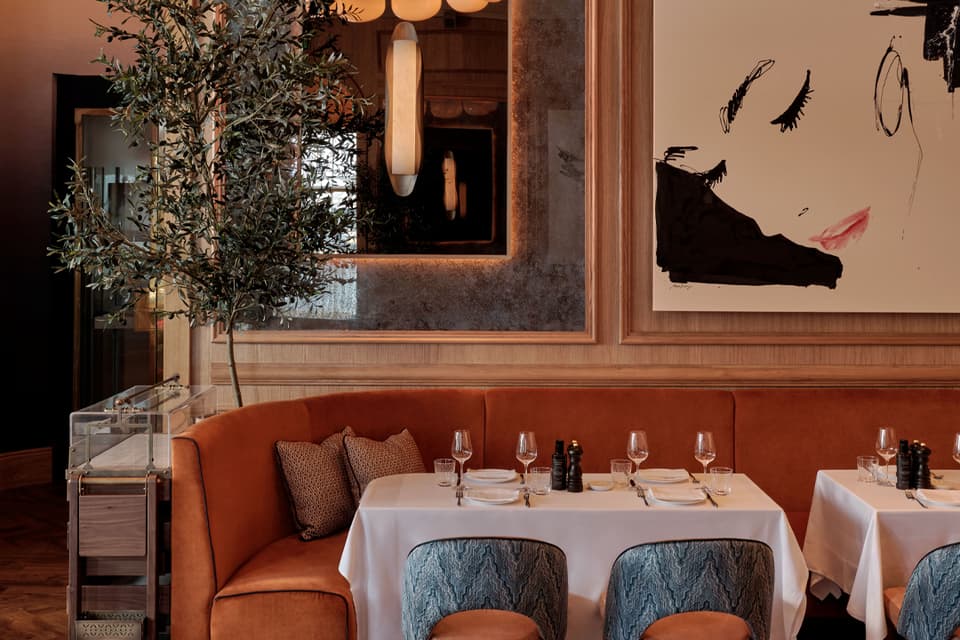
If craftsmanship is one theme shaping London’s dining rooms, glamour is another. At Sale e Pepe Mare, newly opened within The Langham, marble surfaces, rich Italian fabrics, white tablecloths and a dramatic 16-foot bar channel the romance of the Italian Riviera.
Manuela Hamilford of Hamilford Design explains: “We wanted dining at Mare to feel like a fabulous dinner party with friends. “The deep blue tones were inspired by the Italian coastline and the colours of Puglia, balanced with timber, marble and brass to give the restaurant a sense of northern Italian elegance.”
That same sense of occasion defines Dante Mayfair, now permanently housed within Claridge’s. Designed by Nathalie Hudson with Bryan O’Sullivan Studio, the interiors combine limewash finishes, green and blue ones, gilded detailing and botanical murals by Beth Rodway. Josef Hoffmann-inspired lighting, David Yarrow photography and a honky-tonk piano lend the restaurant a cinematic quality.
Get the look
Cece’s – Daisy Moiré lampshade: £295, Tinkerandtallulah.co.uk
Miko Meo Fair –New Eden Midnight Wallpaper: £95 per roll, Grahambrown.com
Weezie’s – Red and neutral Orchard Stripe cushion: From £125, Fermoie.com
Cafe 1922 – Stackable orange chair: £235, Worm.co.uk
Cafe Jikoni – napkins: £10, Jikonilondon.com
Vesper – torch rug: From £1,700, Kermainegallacher. com
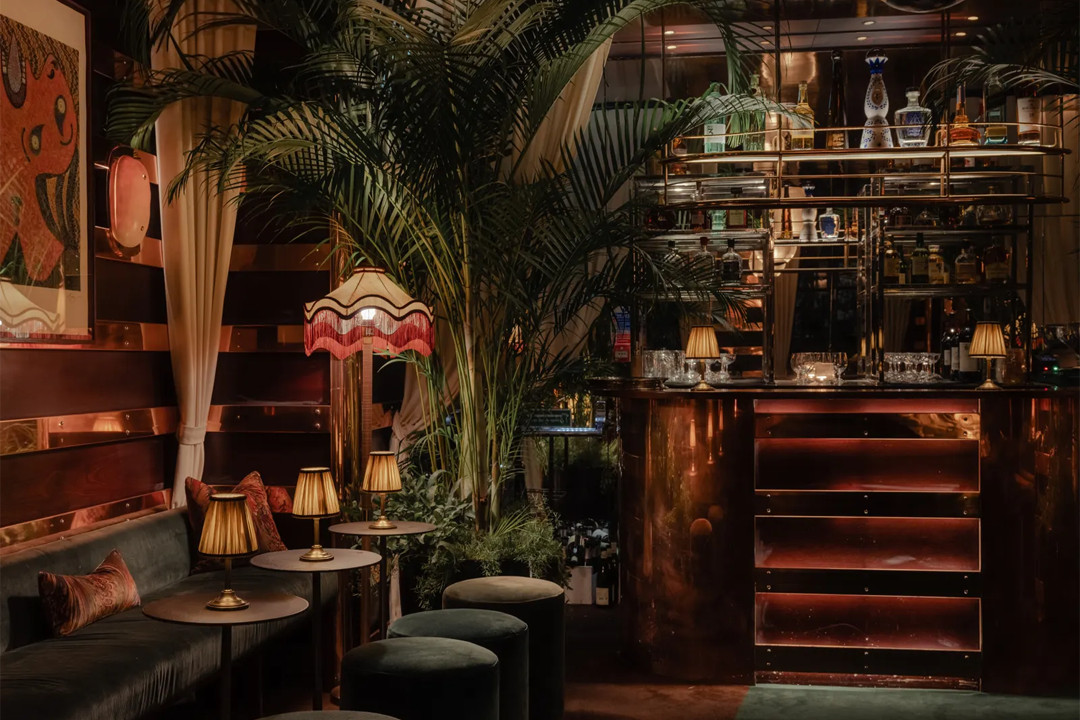
In Notting Hill, CeCe’s (from the team behind The Pelican) takes a similarly glamorous approach. “We fell in love with the glamour and unique design,” says co-founder Olivier van Themsche. “The surreal interiors and character hidden behind the copper door inspired us to create a restaurant that felt both current and exciting, while retaining the allure of traditional hospitality.” Soft fabrics, glossy finishes, palms and low lighting create an atmosphere that feels both intimate and theatrical.
At Vesper in Clerkenwell, Jackson Boxer’s new restaurant occupies a handsome corner site designed by Jermaine Gallacher. A studded zinc bar by Laurence Andrew Chalk sits alongside hand-carved limestone panels by Tom Pullen and bespoke metalwork by sculptor Will Jack. The result feels closer to a collector’s interior than a conventional restaurant.
That appreciation for collecting also defines Osteria Vibrato in Soho. Designed by founder Charlie Mellor, the restaurant honours the traditions of the Italian trattoria with white tablecloths, Murano chandeliers and bespoke red leather banquettes. At the rear, an intimate cocktail bar sits alongside artworks sourced through Soho gallerist Cedric Bardawil and an audiophile sound system.
Just around the corner, Impala in Soho is the debut restaurant from chef Meedu Saad, who draws on his Egyptian roots. Designed by Benjamin Chapman and Dan Preston, the restaurant draws inspiration from the work of Carlo Scarpa and Carlo Mollino. Concrete pillars, figured veneers, dramatic skylights and bespoke lighting create a richly layered interior, while a speaker system built from repurposed cinema horns acts as both sculpture and sound system.
Soho House founder Nick Jones’s St Clement hotel on The Strand, which will include a new restaurant by Florence Knight later this year, has interiors by Eagle + Hodges. With 15 suites and 100 residential apartments, it is set to become one of London’s most coveted addresses.
 Holy Carrot
 Meanwhile, one of the most ambitious openings of the summer is Latine in Mayfair. Designed by Victoria Vogel, the restaurant unfolds across four floors inspired by South American haciendas and French decorative traditions. Limewashed walls, terracotta accents, parquet flooring and hand-painted murals create a sequence of spaces that shift from bright and welcoming by day to atmospheric by night.
“We wanted Latine to feel transportive but still grounded in Mayfair,” says Vogel. “Balancing Latin warmth and energy with a more refined European approach.” Across town at Café Jikoni inside V&A East, founders Ravinder Bhogal and Nadeem Lalani Nanjuwany worked closely with architects O’Donnell + Tuomey to create a space inspired by the restaurant’s multicultural identity. “We wanted to bring elements of our original home, Jikoni, into the space,” says Nanjuwany. “Particularly the warmth of mid-century rosewood and pops of faded pink, mango and pomegranate colours, referencing the many cultures we cook from.”
Whether inspired by the glamour of the Amalfi Coast, the traditions of Lucknow or the decorative arts, the strongest restaurant interiors tell a story.