
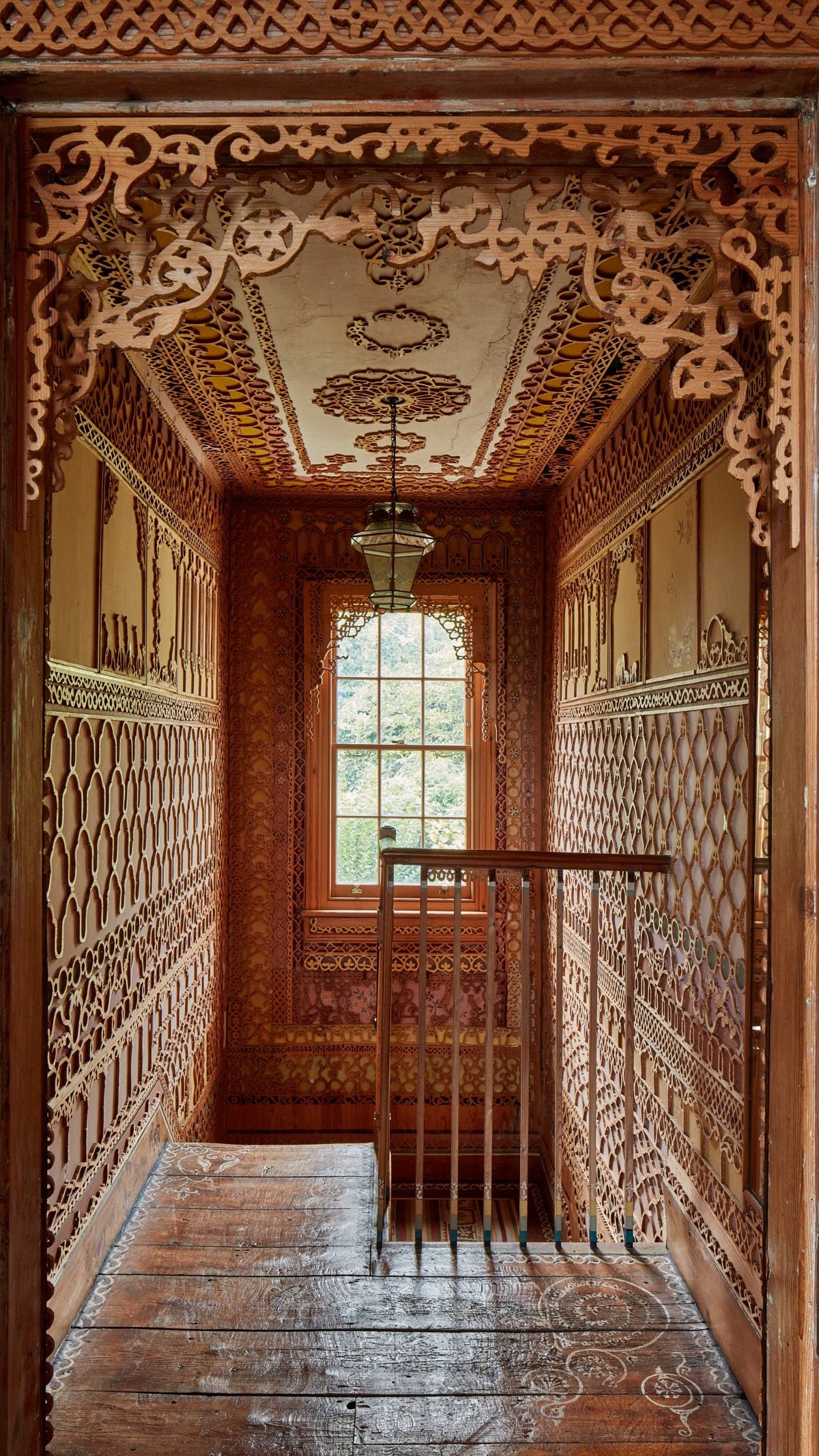
Behind a modest Wandsworth front door lies a work of national significance. From the outside, No 575 Wandsworth Road is a charming late-Georgian terraced house. Modest, at two storeys high, built in brick and stucco with a basement below and a front door approached by steps and iron railings. Sure, it is pretty, but nothing that Londoners are not used to seeing across the city.
But there are clues that this place is not all that it might at first appear. Firstly, without a number on the door, the house seems to be trying to keep itself deliberately anonymous, the windows are dark, the curtains and shutters often drawn. Second, despite this, there will often be a small crowd gathered outside waiting to be let in. It is also listed, alongside its neighbour, placing it in the top two per cent of the country's building stock because of its historic significance. And perhaps the biggest give-away is that it is owned by the National Trust, whose remit is to look after special places, forever, for everyone.
One man's 25-year obsession
What makes 575 so special that it warrants the protective embrace of the UK's largest conservation charity? Open the door and all becomes clear. Inside, this is not a late Georgian terraced house: it is a confection inspired by Granada's Alhambra and the Great Mosque of Córdoba, with echoes of Constantinople, Damascus and Zanzibar, an eye-popping mixture of Ottoman, Moorish and African decoration. In Wandsworth, a fairly quiet and leafy part of south-west London.
The answer, back in 1981, was not a lot. The house was in a poor state: squatters had moved in and the basement leaked water from a commercial laundry next door. Not an ideal prospect, save for a man looking for a bargain while trying to survive the expense of living in London. That man was Khadambi Asalache, a Kenyan-born civil servant of many talents, an architect, artist, writer, broadcaster, teacher and gardener.
Asalache had moved to England two decades previously, in 1960, and had accumulated a fascinating career working for the BBC African Service, writing novels inspired by his homeland and poems about voluntary exile. He also turned out to be the most brilliant fretwork craftsman. Working for the Treasury at the time and looking for a place to live, Asalache cast his search along the route of the number 77A bus, knowing it would take him straight to the Whitehall office door. And it was there he spotted the doer-upper that would be his home for the next 25 years. He bought it and handed over less than the £31,000 asking price.
Asalache not only restored the house, he turned it into a work of art. At first, the carvings were practical, a way of concealing damaged walls and damp plaster. But the work turned into an obsession. Over many years, working largely alone, he filled every surface with carved pine, turning abandoned doors, used wine boxes and old floorboards into pierced fretwork panels depicting flowers, stars, crescents and hearts amid a maze of intertwined strapwork.
Birds and marching elephants
There are animals too: birds perch among the decoration below the windows or above the doors, elephants march across painted walls, while villagers walk to market driving their stock before them. If you glance up at the ceiling, the corners are filled with a cascade of carving, tiered and intricate niches that hang like honeycombs, miniature wooden versions of the plaster and tile muqarnas found across the Islamic world.
It is not all about the carving: there are paintings and artefacts, too. Asalache collected 19th-century English lustreware, a type of pottery decorated with an iridescent glaze, giving it a metallic look. Despite being English, it is not out of keeping with the rest of the interior: lustreware is rooted in the flamboyant ceramic traditions of the Middle East and North Africa.
"It is a breathtaking place"
Tim Knox, then the director of Sir John Soane's Museum, called the house a work of national significance. Which is extremely high praise. Soane was architect to the Bank of England, a wealthy man who spent decades filling a grand Lincoln's Inn townhouse with antiques. Asalache was a civil servant on Wandsworth Road, armed with a chisel and an excellent eye for skips. It is a breathtaking place. One well worth your time, a hidden treasure in an everyday house.
John Darlington is Director of Projects for World Monuments Fund.