Mumbai dreams: India’s night schools give women a second chance at education
Juggling work and school is often too much for the poorest women and girls in India. Mumbai’s night schools offer a lifeline for those hoping to change their futures
ABOUT THIS PROJECT

Pinky Jaiswal is ambitious. She wants to work in a bank. But there is a hurdle: she failed her tenth-grade exam when she was a teenager studying in Kanpur in Uttar Pradesh in northern India. For the longest time, she thought that would be the end of her education. Now 30, she lives in Mumbai with her husband and five-year-old daughter. In June 2022, she took a bold step. She enrolled in the eighth grade in one of Mumbai’s many night schools.
“I want to study so that I can stand on my own two feet – and so that my daughter does not have to live a life like mine,” Pinky says. “My future has been ruined; hers should not be.”
It was a leap of faith. When she failed the final exam all those years ago in Kanpur, her father refused to pay for her to continue to learn.
“My father was unwell and said that since I had failed, he would not spend any more money on my education,” she explains. Her father died soon after and she moved in with her aunt, who lives in Mumbai. The tenth grade certificate that she’s working towards could elevate her from housewife to bank employee – transforming not only her future, but that of her daughter.
Across Mumbai, a network of 150 night schools serve as a last chance for girls and women to complete their school education. These schools, often functioning in municipal day school buildings, run after school hours, typically from 7 pm to 10 pm, offering working students of all ages an opportunity to learn.
The classrooms are worn, but they hold the dreams of their students.

Stories like Pinky’s are typical. “Nobody comes to the night school who doesn’t have a problem at home,” she says. Someone doesn’t have a mother or a father, someone doesn’t have money at home. “These are all reasons people come to night schools. People come to night schools because they have to work during the day. Otherwise they would go to day schools to study.”
The Covid pandemic exacerbated the situation. Many children stopped going to school because the burden of household work, or even of supporting their families by earning money, fell on their shoulders – and disproportionately onto girls.
At the peak of the school closures due to Covid waves, 247 million students were affected in India. According to figures from UNICEF, Unified District Information System for Education Plus (UDISE+) 2020-21, the annual dropout rate for secondary level education was 14.6 per cent.
Take Muskaan*, 14, a ninth-grade student. Her school shut down in the Covid lockdown and continued to charge fees. It says she owes them Rs 25,000 (around £260) for her lost year. A few months ago, her father and sole breadwinner of the household, died. The night school, run by Mumbai’s municipal corporation, offered Muskaan a path to complete her school education for free, with textbooks provided on loan to students each year.
Haseena, 20, and Isha, 21, are Pinky’s classmates in the eighth grade. They juggle their catering jobs together with night school. Often they get called in to work just two or three hours before a shift that typically extends well after midnight. On those days, they have to miss classes. The pandemic made it even more urgent that they work, Isha said. Her family used to be able to buy groceries once a week; now, they struggle to shop monthly.
Haseena and Isha are part of a group of four friends who signed up for eighth grade together. The night schools require minimum documentation and charge no fees. Haseena, who dropped out of school as a young girl, is learning to read for the first time.
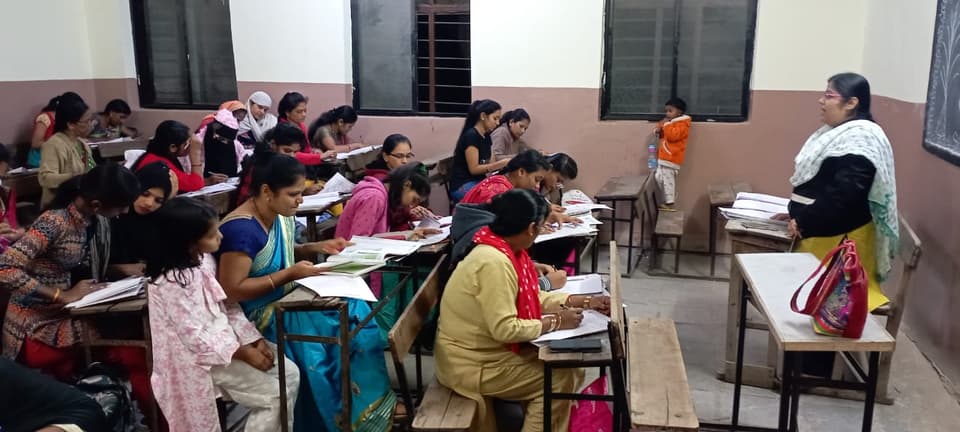
They are recovering something they missed out on earlier in their lives
Night schools have a long history in Maharashtra, whose capital is Mumbai, formerly Bombay. The first night school for labourers and agricultural workers was opened in Pune city in 1855, in the face of opposition from people who believed so-called lower castes should receive only vocational training. Later in Mumbai, night schools thrived as learning centres for its mill workers.
“Night schools are a good way of educating people on the margins of economy by letting them study in the evenings,” says Arun Kumar, a historian at the University of Nottingham. “If these schools are successful, it shows that it is a failure of the system that these students were left out. These adults are now recovering something that they missed out on earlier in their lives.”
Today, in Mumbai and across India, especially in its industrial centres, night schools are a vital resource that allow the poor and working class a chance of literacy and a new future.

Pinky found out about the night school from her husband, who had studied there himself before they were married seven years ago. He is now a gardener on contract with Mumbai’s municipal corporation.

