Efforts to contain an “explosive” outbreak of meningitis are being ramped up as NHS chiefs declared a national incident.
Some 15 cases of meningitis have so far been reported to the UK Health Security Agency (UKHSA), including two deaths.
The agency said all 15 cases had required hospital admission, with four cases confirmed to be meningitis B.
Around 5,000 students in university halls in Kent are to be offered the menB vaccine from Wednesday.
UKHSA chief executive Susan Hopkins said the outbreak looks like “a super-spreader event, with ongoing spread within the halls of residence in the universities”.
She said: “I can say that in my 35 years working in medicine, in healthcare and hospitals, this is the most cases I've seen in a single weekend with this type of infection.
“It's the explosive nature that is unprecedented here - the number of cases in such a short space of time.”
Four schools across Kent have now confirmed cases and hundreds of people are being offered antibiotics as an immediate treatment.
All reported cases so far have a link to Kent, according to the UKHSA.
At least one person who fell ill and had links to Kent attended a hospital in London.
Follow the latest updates below...
Live updates
'Too early to say' whether national vaccination programme should be rolled out
Asked if a national vaccination programme should be recommended by the Joint Council of Vaccination and Immunisation, Kent County Council's director of public health Dr Anjan Ghosh said in his view "at this point it's too early to say".
He said: "This has come up many times.
"I'm sure they're going to look at this properly, already they are."
Health expert 'fairly certain' peak has passed
A health expert is “fairly certain” the peak from the initial “super-spreading” event has passed.
Paul Hunter, professor in medicine at the University of East Anglia told the BBC: "The incubation period, though a little uncertain, ranges from two to 10 days so I think we can be fairly certain that the peak from the initial superspreading event will have already passed.
"The question remains whether there will be any secondary cases i.e. any cases that didn't get their infection from the night club but from someone else who did attend.
"Hopefully the antibiotic and vaccine will prevent those, but still a possibility. Even if we do see secondary cases, I doubt there will be as many as in the primary wave, though cannot be certain."
People eligible for antibiotics or vaccine are urged to come forward
At a press conference at the University of Kent on Friday, Kent County Council director of public health, Dr Anjan Ghosh, said that contact tracing has been done for more than 10,000 people encouraging them to come forward.
He said the particular outbreak was meningitis B and urged for anyone showing symptoms to immediately seek help.
On the extension on the vaccine, he said: "Now message is very simple if you have had antibiotics in relation to this particular incident or are eligible for it you are also eligible for vaccination so do come forward."
Kent school pupil tests 'negative' for meningitis
One of the Kent schools that previously had a suspected meningitis case has confirmed their student has tested negative.
Duncan Beer, headteacher of Highworth Grammar School in Ashford, said in a statement: "We have received information from the UK Health Security Agency that the test was negative for meningitis for our Highworth student.
"The family has confirmed this with us and the student is doing well. Therefore, we have been advised that there is no need for anyone to receive any antibiotics or vaccinations in connection to this person nor the school.
"However, there may be some people who meet the other criteria of eligibility for antibiotics or vaccinations and we have directed our school community to that information."
What do we mean by confirmed and suspected cases?
Doctors diagnose meningitis based on symptoms and start treatment immediately if it’s suspected, due to its seriousness.
These are called “suspected” cases and must be reported to public health teams so they can track patterns and protect others.
A case is only “confirmed” after laboratory tests verify the disease.
NHS vaccine should offer protection against strain of meningitis in Kent outbreak
The Bexsero vaccine for menB used on the NHS should offer protection against the strain identified in the outbreak, officials said.
The UKHSA said in a statement: "As part of investigations, UKHSA laboratories have completed an initial genetic analysis of a meningococcal strain isolated during this outbreak.
"Results have confirmed that the Bexsero vaccine currently being offered in Kent should provide protection against the strain identified.
"The strain belongs to a group of bacteria known as group B meningococci, sequence type 485 belonging to the larger clonal complex ST-41/44.
"Similar strains have been circulating in the UK for around five years but detailed analysis of the outbreak pathogen is required."
It said it was publishing the available data "so that national and international partners can also carry out further scientific research".
As of 5pm on Thursday, some 2,360 vaccinations have been given and 9,840 doses of antibiotics to those affected by the outbreak.
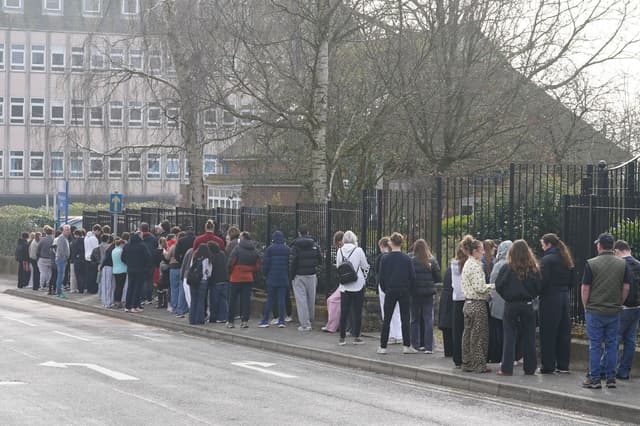
Long queues outside vaccination hubs in Kent
Long queues of people waiting for vaccinations have been spotted in Kent.
It comes as the vaccination rollout is well underway, with 2,360 vaccinations handed out and over 9,000 doses of antibiotics.

Cases increase to 29, UKHSA confirms
The number of meningitis cases linked to an outbreak in Kent have increased to 29, the UKHSA has said.
As of 5pm on March 17, 9 laboratory cases are confirmed and 11 notifications remain under investigation, bringing the total to 20.
Six of the confirmed cases are confirmed to be group B meningococcal disease.
One person who had resided in Kent presented to a London hospital with no community contacts in London, the UKHSA said.
All those affected who are currently linked to the outbreak are young adults.
UKHSA is aware of a baby with confirmed Meningococcal group B infection who is not currently linked to the outbreak but the agency will continue to investigate this case.
People turned away due to 'staffing issue' yesterday, UKHSA chief says
The chief scientific officer of the UK Health Security Agency (UKHSA), Professor Robin May, said a "staffing issue" led to people being turned away from the queue for a meningitis B vaccine.
More than 100 students were told to leave the queue by staff on the University of Kent Canterbury campus on Thursday afternoon, after the university said "nursing staff are unable to see any more people within the clinic's remaining opening hours today". The clinic closed at 5pm.
Prof May told Times Radio: "Yesterday, it was a staffing issue. To emphasise - we are not short of vaccine. Yesterday, demand exceeded the ability of staff to fulfil it within the time allocated.
"I would like to really stress that the frontline response for people who are exposed is prophylactic antibiotics, which have now all been given, so people who have been exposed have had antibiotics to protect them from disease.
"The vaccination that we're offering now is for follow-up protection, but those students who are on antibiotics are already protected.
"Nonetheless, we are encouraging people who are eligible to get their vaccine clearly, but the fact that they might have had to wait a day or two is not an immediate health risk."
First students join the queue for the MenB vaccine
Around 700 staff and students were in queue to get a vaccine at the University of Kent by 8.45am on Friday morning.
The campus was busy as students and staff lined up outside the sports centre to receive the jab following the outbreak of meningitis.
One student near the front said she had joined the queue at 7.55am.
The clinic is operating from 9am to 5pm, with students told to join the queue by 2pm.